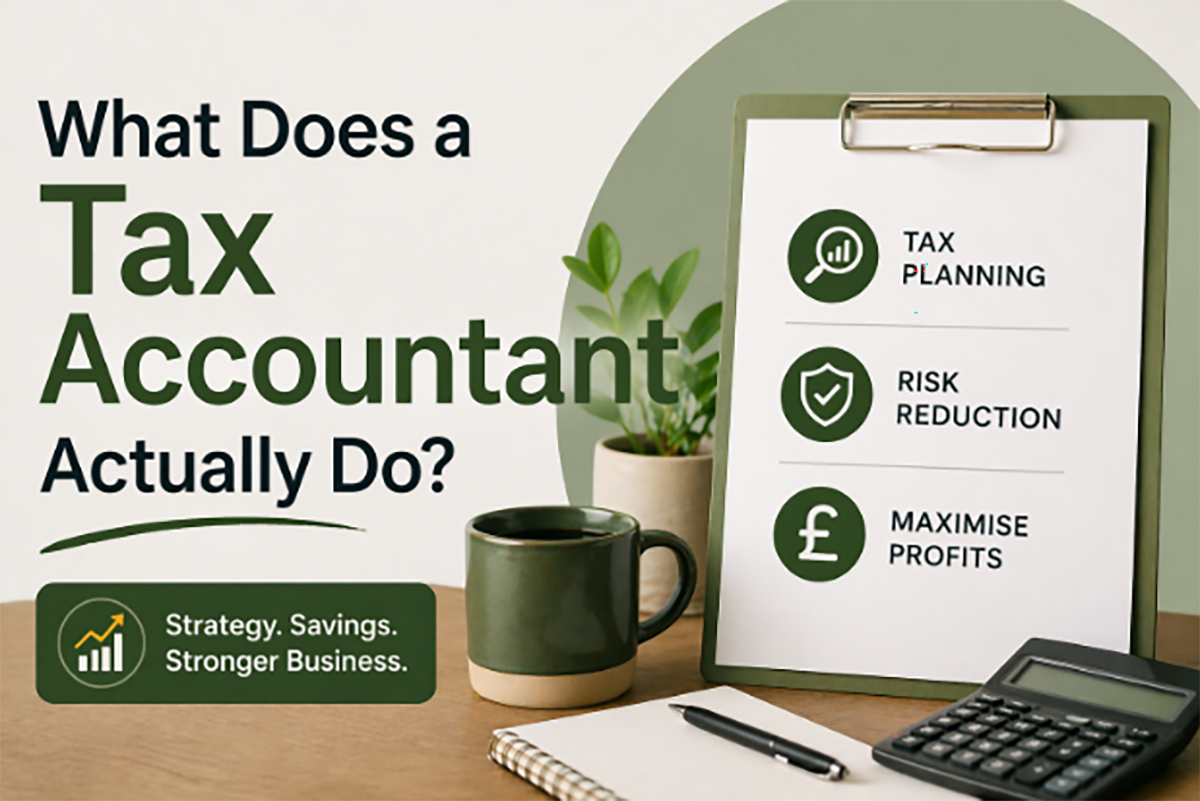
Many business owners view their annual accounting cycle as a purely historical reporting exercise completed simply to keep HM Revenue & Customs (HMRC) happy. If your relationship with your finance professional consists of handing over a shoebox of digital receipts in December and receiving a tax bill in January, you might be confusing basic compliance with actual financial advisory.
Here is a closer look at the difference between a high-volume, reactive service and high-end financial advisory.
Are you paying for a basic bookkeeper or a proactive tax accountant?
Entrepreneurs often settle for basic data entry instead of financial foresight. A basic bookkeeper or a "cheap" volume-based accountant is focused entirely on the past, ensuring the ledger balances, the invoices are logged, and the standard tax return is filed. This leaves the business owner operating blindly, with a finance department that functions merely as a reactive cost centre.
You need a professional who actively engineers your financial future. So, what exactly does a high-end tax accountant do? A true specialist providing comprehensive small business accounting in London is constantly scanning the horizon. They analyse your gross margins, forecast complex cash flows, and construct sophisticated strategies to ensure that every penny of wealth you generate is legally protected and highly tax-efficient. They shift your finances from a reactive burden to a proactive profit driver.
What strategic tax planning should my accountant be doing before the financial year-end?
The most expensive mistake a business owner can make is waiting until after their financial year-end to ask for tax advice. Once the clock strikes midnight on your company's year-end date, the vast majority of tax-saving opportunities completely vanish. The die is cast, and your corporate tax liability is legally locked in.
A proactive professional operates on a completely different timeline. They initiate rigorous pre-year-end tax planning sessions in month nine or ten of your financial year. This provides the necessary runway to evaluate the optimal, mathematically sound mix of salary, dividends, and pension contributions, which sits at the core of robust personal tax planning. They will also advise on timing major equipment purchases to utilise the Annual Investment Allowance (AIA) and ensure overdrawn director's loan accounts are cleared to avoid punitive HMRC charges.
Why is my current accountant only contacting me right before the HMRC deadline?
If the only correspondence you receive is an automated email demanding your records in late December, you are trapped inside a volume-based business model. Firms operating on exceptionally thin margins rely on high client turnover. To remain profitable, their staff must churn through hundreds of returns quickly. In this transactional environment, there is simply zero bandwidth for bespoke advisory, deep financial analysis, or proactive communication. This inevitably leads to nasty financial surprises and sudden cash-flow crises when unexpected tax bills arrive.
When you partner with a dedicated, advisory-led tax accountant in London, you are fundamentally paying for continuous communication and foresight. You will know exactly what your projected tax liabilities are months in advance. This grants you ample time to save, adjust your growth strategy, or strategically reinvest capital to lower the final bill before the deadline becomes an emergency.
How does a chartered tax advisor differ from an unregulated bookkeeper?
One of the most concerning facts about the UK financial services industry is that the term "accountant" is not legally protected. Technically, anyone can set up a website, call themselves an accountant, and begin handling sensitive corporate data without holding any formal qualifications. Entrusting complex wealth structuring to an unregulated individual puts your business at severe financial and legal risk.
You must secure a fully chartered professional. Chartered advisors have endured years of gruelling technical examinations, are strictly bound by ethical codes, hold mandatory professional indemnity insurance, and complete rigorous continuous professional development (CPD). If you are looking to ring-fence generational wealth, a chartered advisor possesses the technical authority to design, legally implement, and seamlessly manage a bespoke structure like a Family Investment Company. An unregulated bookkeeper simply will not have the regulatory clearance or complex legal knowledge to do so safely.
Lawrence Grant LLP is a reputable firm of Chartered Accountants based in Harrow, London, established for over 50 years. They provide comprehensive audit, accounting, and tax advisory services, specialising in UK and international tax planning for businesses and individuals, ensuring your wealth works just as hard as you do.
We're not a fan of spam either, so we will not pass on your information onto any 3rd parties. What you give to us, stays with us.